The concept of the “Mafia Egg,” which Dr. Lê Kiên Thành—son of the late General Secretary Lê Duẩn—warned about not long ago, is no longer just a vague theoretical hypothesis.
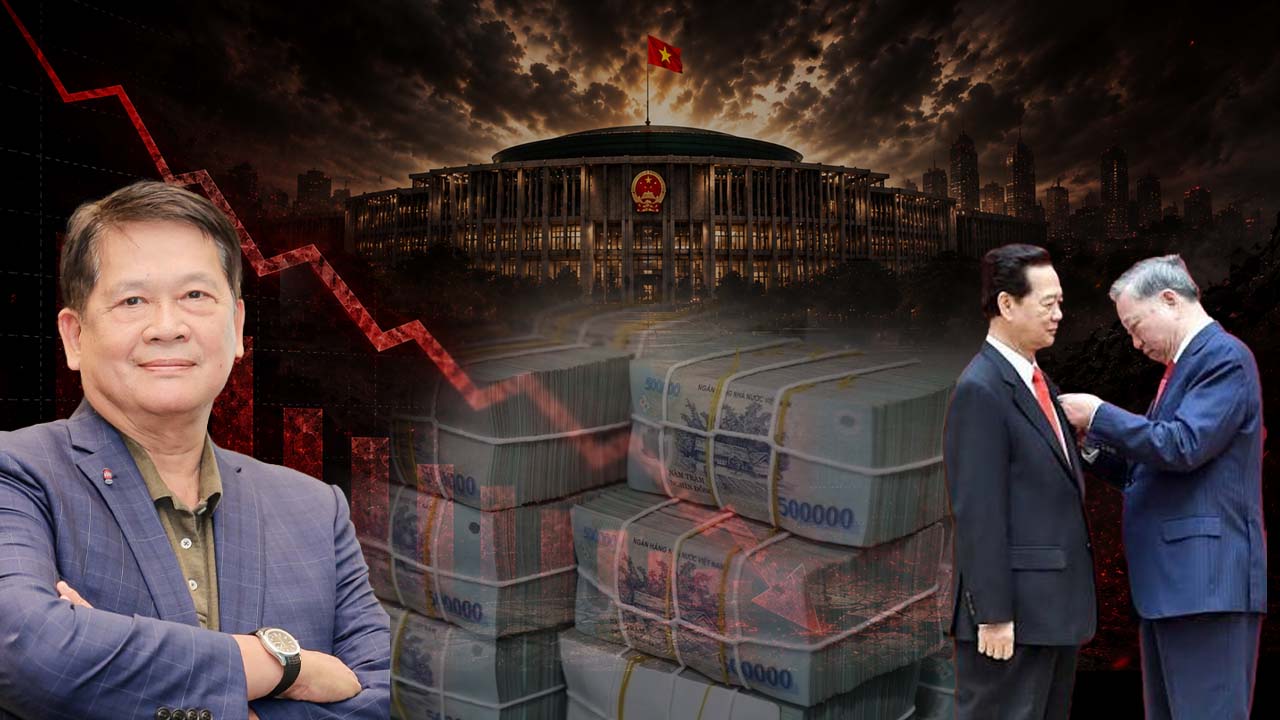
It highlights the seeds of organized crime taking root in ultra-profitable economic sectors, where “interest groups” pose a hidden risk of manipulating the system and threatening the stability of the political regime—a trend that is surging with great force.
According to observers, while corruption exists in every country, in Vietnam it has reached an extremely severe level. Government officials have colluded with “shark-like” businesspeople; corruption is ravaging the country and undermining the regime’s legitimacy in the eyes of the people.
Accordingly, the recipients of bribes are government officials, and the bribe-givers are businesspeople involved in shady business deals. This relationship operates in two directions, depending on whether the state acts as the buyer or the seller.
When the state acts as the buyer—in massive infrastructure projects ranging from roads and seaports to public housing—it is inevitable that it will facilitate the takeover by capitalist groups.
Conversely, when the state acts as the seller—through privatization, land auctions, or the granting of rights to operate public services—it also cannot escape the corrupt influence of these interest groups.
The series of shocking major scandals that have been exposed in Vietnam in recent years has proven the points just mentioned.
These include the Vinalines and Mobifone acquisitions of AVG, the Vạn Thịnh Phát and Nhàn-AIC scandals, the “Rescue Flights” scandals, and crony conglomerates such as Phúc Sơn, Hậu Pháo, and Nguyễn Duy Hưng’s Thuận An.
These cases have not only swept away tens of billions of dollars but have also implicated a host of high-ranking officials—from the “Four Pillars” to numerous other senior leaders—who have either fallen from grace or been disciplined and removed from office.
Recognizing the nature of this problem, at a working session with the Central Internal Affairs Commission on September 29, 2025, General Secretary To Lam bluntly identified what he called the “Alliance of Officials, Businessmen, and Criminals,” which is essentially a criminal conspiracy.
According to international analysts, the fact that the head of the Communist Party of Vietnam courageously and publicly named this diabolical alliance is a commendable and bold move.
However, a far greater challenge lies ahead: the risk that this diabolical alliance will transform into an “unofficial dynasty” dominating the entire nation.
That is, when a single overlord officially emerges who holds the power to control all the tycoons manipulating the economy. At that point, the state apparatus will degenerate into a “mafia state” in the truest sense.
Notably, a significant portion of Vietnam’s tycoons have quickly adopted the model of post-Soviet oligarchs. The case of billionaire Trinh Van Quyet being acquitted is a prime example.
Consequently, the relationship between the mafia and the political class is becoming the most serious threat to the survival of Vietnam’s political system at this time.
Consequently, the challenge facing Mr. To Lam today goes beyond merely handling individual corruption cases or prosecuting corrupt officials one by one.
To prevent the risk of the Vietnamese state being manipulated by economic mafia groups, General Secretary and President To Lam must fundamentally dismantle the “ask-give” mechanism.
At the same time, it is necessary to thoroughly ensure transparency in the bidding processes for public assets and land, and to tighten control over power so that officials cannot sell off assets and their crony business associates cannot buy or manipulate policies.
If the “mafia” problem is not stopped right now, the Communist Party of Vietnam will certainly “collapse” and face ruin in the face of the omnipotent power of money wielded by the “red tycoons.”
Trà My – Thoibao.de