The story of Vuong Quoc Tuan, the new Secretary of the Quang Tri Provincial Party Committee, who—immediately upon taking office on September 21, 2026—issued a statement declining to accept flowers or receive delegations coming to offer congratulations, might seem like a minor, routine detail. However, in the current political climate, this gesture has drawn particular attention from the public.
Having held leadership positions as Provincial Chairman of Bac Ninh and then Thai Nguyen before being transferred to Quang Tri in just a few years, Mr. Tuan is said to have established an initial reputation for integrity.
Although his work performance in previous localities still needs to be verified, his firm refusal of elaborate congratulatory ceremonies on his very first day in office is a positive development that the public considers worthy of recognition.
However, Mr. Tuan’s personal action inadvertently exposes a chronic problem that has persisted for decades within the leadership apparatus of the Communist Party of Vietnam. That is the culture of congratulating leaders upon assuming new positions.
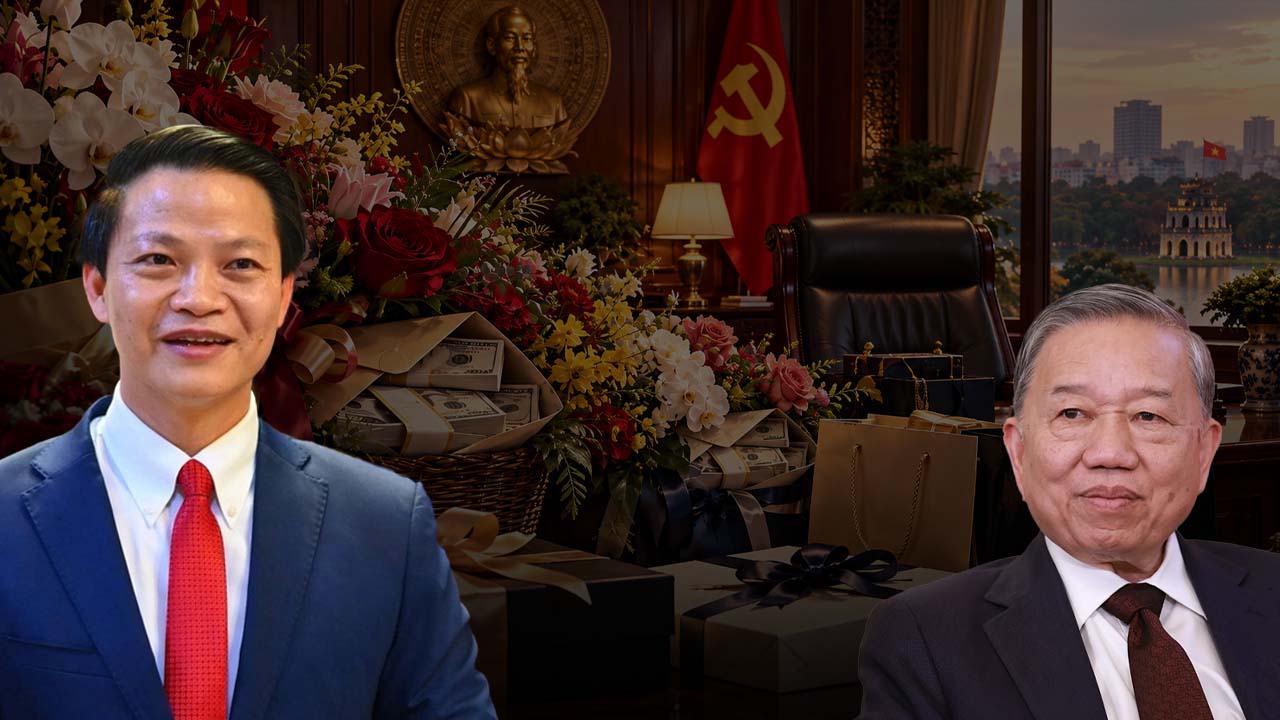
According to Army Colonel Trần Nhung, former Editor-in-Chief of the Veterans’ Newspaper, who recently stated that this is not merely a matter of social courtesy or basic politeness, but has degenerated into one of the most dangerous and sophisticated forms of open bribery used to “curry favor” with superiors.
Accordingly, whenever a high-ranking leader receives an appointment decision, a familiar scenario unfolds: government agencies, mass organizations, businesses, and individuals line up one after another, flocking to present flowers and gifts during their visits.
But no one can measure or control the actual material value contained within those flower arrangements.
According to Colonel Trần Nhung, the history of Vietnam’s anti-corruption efforts has documented lessons regarding this level of sophistication. Specifically, former General Secretary Lê Khả Phiêu once discovered an envelope containing tens of thousands of USD neatly tucked inside a congratulatory flower arrangement.
This was an extremely “surprising” detail that made Lê Khả Phiêu realize with a start just how deeply corruption had penetrated the system, leading him to resolve to intensify the anti-corruption campaign to clean up the government.
Similarly, there is the story of Mr. Hoang Van Nghia during his early days as Chairman of the Hanoi City People’s Committee (1994), when he asked the Office to tally the value of New Year’s gifts received in his first year in office—a figure that reached several billion dong.
More concerning is that this situation often correlates directly with the frequency of cadre rotations. When officials are continuously transferred across multiple localities, the cycles of assuming new positions and handing over duties create opportunities for “natural gains” through legitimate channels.
The sight of bureau- and department-level officials—who have the authority to approve housing and land allocations—recently taking office, with subordinates jostling and pushing just to hand them a “congratulatory” envelope during the Lunar New Year, is a vivid illustration of the distortion of professional ethics.
This “promotion-celebration” culture, as described, has taken deep root, and many view it as a matter of course—a survival skill in the bureaucratic arena. Yet it is precisely this culture that is eroding the public’s trust in today’s leadership.
Public opinion is asking how to put an end to this problem when it has become an ingrained custom. The real solution is by no means easy if it relies solely on the self-discipline or personal integrity of individual leaders.
To prevent this completely, it is time for the Vietnamese Communist Party and the State to issue mandatory regulations tightening civil service discipline across the entire system.
Specifically, there should be an “absolute ban on organizations or individuals offering congratulations, flowers, or gifts upon the appointment or transfer of officials in any form.” At the same time, the assets and income of leadership officials must be thoroughly disclosed before and after each reassignment.
Only when sufficiently strong legal regulations are enforced without exception will the scourge of bribery disguised as congratulatory flowers be eradicated.
Trà My – Thoibao.de