On February 17, 2026, the European Union (EU) officially placed Vietnam on its “tax haven” blacklist—an announcement that sent shockwaves through the country’s international image.
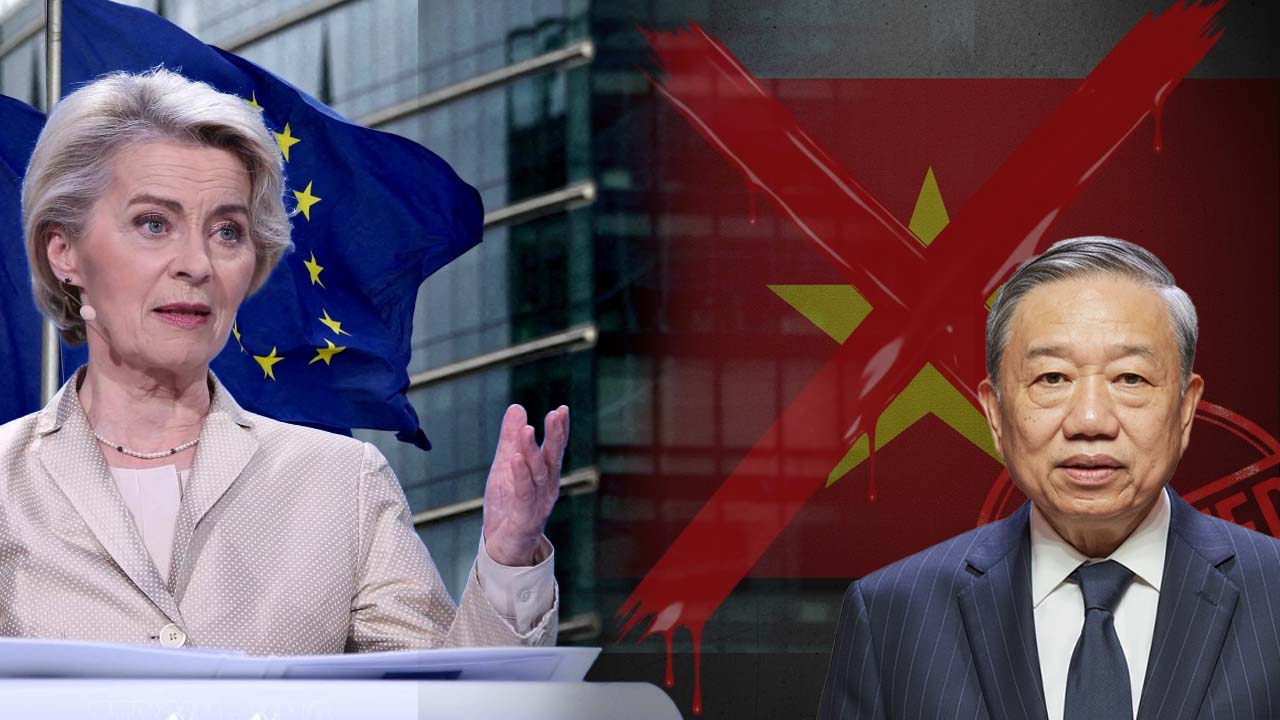
What makes this particularly striking is that the blow came less than half a year after Hanoi celebrated being removed from the “grey list” in October 2025.
This abrupt reversal not only exposes weaknesses in Vietnam’s capacity to implement its international commitments, but also raises serious questions about how genuine the new post–14th Party Congress leadership’s reform rhetoric really is.
According to international financial circles, Vietnam being blacklisted alongside countries such as Russia or Panama is not merely a matter of national reputation; it amounts to an economic verdict with harsh and highly unpredictable consequences.
Under European Council rules, jurisdictions on the “blacklist” face stringent defensive measures from all EU member states.
European companies operating in Vietnam would be prohibited from deducting expenses paid to local partners when calculating corporate income tax in their home countries.
At the same time, dividend payments, interest, and royalty fees flowing from the EU to Vietnam would be subject to higher withholding taxes—ranging from 15% to 30%.
This would directly transform Vietnam’s investment environment from an “attractive” destination into one that is more expensive and riskier than ever, compared with regional competitors such as Thailand or Indonesia.
The causes behind this worst-case scenario lie in Vietnam’s failure to meet three core standards promoted by EU and OECD frameworks: tax transparency, fair taxation, and the implementation of measures to prevent base erosion.
Delays and ambiguity in tax incentive policies—designed to attract capital while lacking substantive real economic activity—have exhausted Europe’s patience.
While General Secretary Tô Lâm repeatedly speaks of a “new era” and ambitious double-digit economic growth targets, Hanoi’s placement on the “tax haven” blacklist represents a serious breach in national governance.
A political system that concentrates power absolutely, yet fails to comply with global transparency norms, appears to have collided with the barrier separating it from the civilized world.
Restrictions on EU FDI inflows and development support would be deep cuts into Hanoi’s ambition to modernize the country—an excessively high price for a nation as hungry for capital and technology as Vietnam.
More seriously still, the designation could cause any financial transactions involving Vietnam to be immediately flagged by international banks. Anti–money laundering and anti–tax evasion controls would tighten, leading to delays and higher transaction costs for import–export businesses.
It would also dampen hopes of upgrading Vietnam’s stock market classification in the near future, as national financial credibility and transparency are being seriously tarnished.
If Hanoi continues to ignore international norms of financial conduct, Vietnam will remain nothing more than a low-cost processing economy, pushed to the margins of the world’s high-value supply chains.
The reality is now clear: no country can rise without accepting the rules of the civilized world—otherwise it will pay in missed opportunities and long-term stagnation under the notorious label of a “tax haven.”
A true rule-of-law state must uphold legal norms not only domestically but also internationally. That is the only path to restoring trust and regaining sustainable growth momentum.
Tra My – Thoibao.de